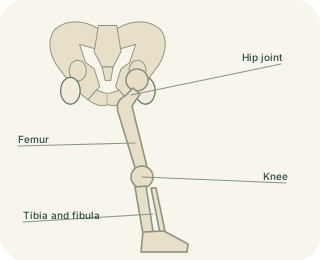
A ball inside a deep socket
The hip connects the rounded head of the femur to the , a cup formed by the pelvic bones. It is a synovial ball-and-socket joint, so it can bend, straighten, move sideways and rotate. These movements position the foot while the pelvis carries the weight of the trunk. Compared with the shoulder, the hip has a deeper socket and generally sacrifices some freedom of movement for stronger support. The femoral neck places the shaft at an angle to the head, helping align the limb under the body.
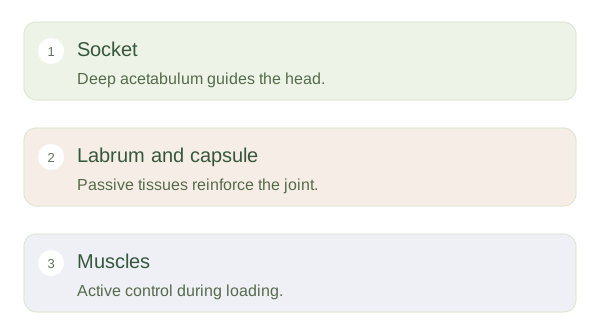
Hip stability partners
 Open diagram larger ↗
Several layers of support
Smooth articular cartilage covers the contacting bone surfaces and spreads forces. A fibrocartilage rim called the deepens the socket and contributes to a seal around the head. A strong surrounds the joint, reinforced by ligaments including the iliofemoral ligament at the front. These ligaments become particularly taut in standing extension. This helps maintain an upright posture without requiring every surrounding muscle to contract at maximum effort. Stability still depends on the position of the joint and the direction of an applied force.
Living support during movement
The gluteal muscles and short rotators guide and stabilise the joint while walking. Their tendons and the work with the socket rather than replacing it. Blood reaching most of the adult femoral head travels through vessels near the femoral neck, making some neck injuries important beyond the broken bone itself. A useful mental model is a supported bearing: the cup guides movement, cartilage distributes load and muscles continually adjust the position. No single ligament or muscle alone makes the hip stable.