One cycle, two main phases
A gait cycle begins when one foot contacts the ground and ends when that same foot contacts again. is the period when the foot is on the ground; is the period when it advances through the air. During ordinary walking, stance takes roughly sixty percent of the cycle, although speed and individual pattern change the timing. There are brief periods when both feet touch the ground. Running differs partly because it includes a flight phase rather than the same pattern of .
Walking tasks
 Open diagram larger ↗
The limb changes its job
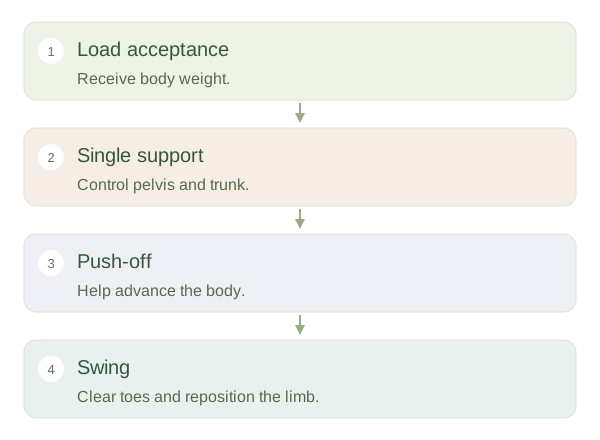
At initial contact and loading response, muscles control the arrival of body weight and help absorb impact. In midstance, the pelvis passes over the supporting foot. Hip abductors stabilise the pelvis, and ankle muscles control the forward movement of the shin. Near terminal and push-off, plantarflexor activity and the foot’s changing stiffness help advance the body. During , the hip and knee flex to shorten the limb temporarily, while dorsiflexion helps clear the toes. Knee extension then prepares the foot for the next contact.
Control is distributed
No single muscle creates walking. Joint motion, sensory feedback, balance, spinal circuits and signals from the brain all contribute. For example, weak dorsiflexion can make toe clearance difficult, while weak hip abductors affect pelvic control. Pain may shorten the time spent on one side, producing a different pattern again. Observing gait therefore reveals useful clues without establishing a diagnosis on its own. The cycle is best understood as a sequence of tasks: accept load, support the body, propel it and reposition the limb. Each task uses overlapping muscles rather than a simple on–off switch.