Cells specialised to release substances
A gland consists of cells adapted to produce and release a material. Secretion may include enzymes, mucus, sweat or hormones. The product is not necessarily waste: it can serve digestion, lubrication, temperature control or communication. Glandular cells commonly contain cellular machinery suited to their particular product. Protein-secreting cells may have extensive rough endoplasmic reticulum and secretory vesicles. Microscopic appearance can suggest activity, but identifying the exact product often requires the organ context or a specific stain rather than shape alone.
Where does the secretion go?
 Open diagram larger ↗
Two main delivery routes
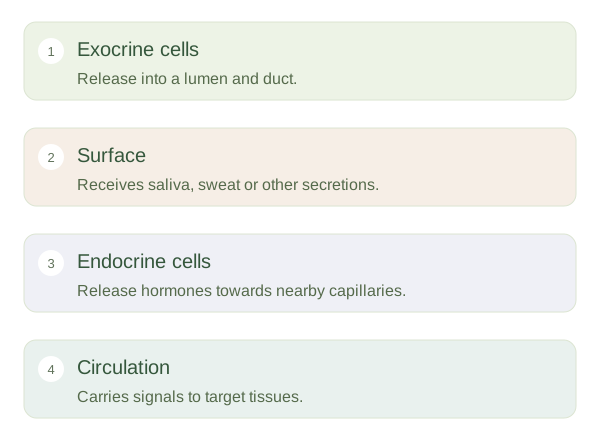
glands release their products onto an epithelial surface, often through ducts. A salivary gland sends fluid into the mouth, and sweat glands deliver fluid to the skin. glands release hormones into surrounding tissue fluid, from which they enter the circulation. They do not use ducts to reach a surface. Their cells often lie near capillaries, allowing efficient exchange. The pancreas contains both exocrine acini producing digestive secretions and endocrine islets releasing hormones. This shows why one organ should not always be assigned only one gland category.
Architecture supports the task
glands can have tubular or rounded secretory units, with simple or branching duct systems. Mucous products are relatively slippery and protective, while watery serous secretions often contain proteins such as enzymes. Many glands use exocytosis, in which vesicles fuse with the cell membrane. Other specialised secretion methods exist, including release of whole disintegrating cells by sebaceous glands. When reading a section, look for secretory units, a lumen, ducts and nearby vessels. A visible duct suggests an exocrine pathway; a cluster beside capillaries without ducts may suggest organisation, but the wider tissue pattern remains essential.