Three terms answer different questions
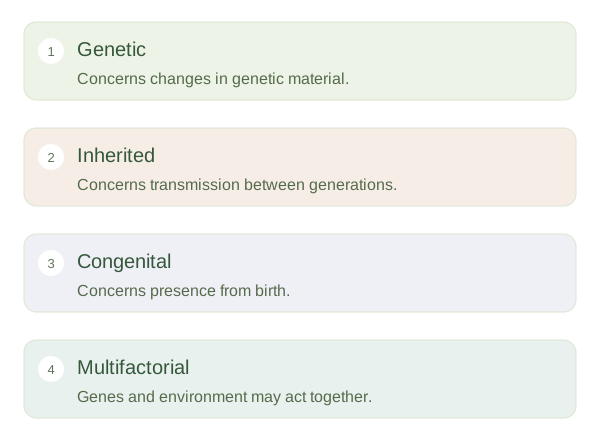
A genetic disorder involves a change in genetic material that contributes to disease. An condition is passed through reproductive cells from parent to child. A condition is present from birth, although it may be recognised later. These categories overlap but are not identical. A new genetic change can occur in an egg, sperm or early embryo without being present in either parent. Conversely, some inherited conditions do not become apparent until adulthood. The terms describe mechanism, family transmission and time of origin respectively.
Three overlapping descriptions
 Open diagram larger ↗
Changes at different scales
A gene variant changes a DNA sequence; its effect may be harmless, harmful or uncertain. Some disorders result mainly from one gene, while others involve many genes interacting with environmental influences. Chromosomal conditions involve larger changes in chromosome number or structure. The same variant can have different effects depending on other biological factors. Genes do not operate as simple switches controlling an entire person’s fate. They help build and regulate proteins within a changing cellular and environmental context. Interpreting a genetic result therefore requires more than noticing that a difference exists.
Development can be affected in several ways
abnormalities may involve genetic changes, environmental exposures, maternal illness or combinations of influences during development. Sometimes no single cause is established. The developmental stage matters because different organs are forming at different times. A structural heart difference present from birth and an metabolic disorder are not necessarily caused by the same kind of process. Family history can guide investigation, but absence of a family history does not exclude a genetic condition. The useful habit is to ask separate questions: what biological mechanism is involved, how might it be transmitted and when did the difference arise?