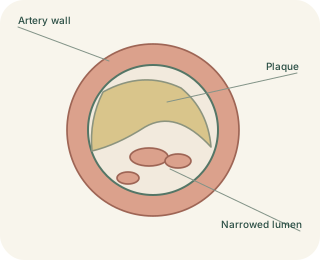
Plaque develops within an arterial wall
is a disease of arteries in which lipid accumulation, inflammation and tissue changes create plaques within the wall. It is not simply loose fat floating through a pipe. Plaques may gradually narrow the channel and alter the behaviour of the vessel. Their composition and stability matter as well as their size. Coronary arteries supply the heart muscle itself, so disease in these vessels threatens the muscle that powers circulation. The blood passing through the heart chambers does not directly nourish every muscle cell in the wall.
A common heart-attack pathway
 Open diagram larger ↗
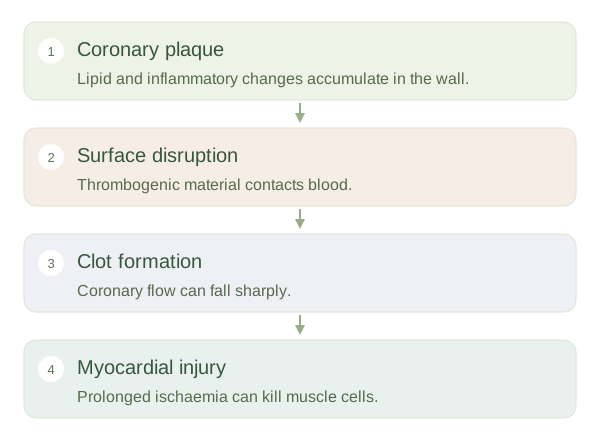
From a chronic plaque to an acute event
If the surface of a coronary plaque ruptures or erodes, blood encounters material that promotes platelet activation and clot formation. A rapidly forming thrombus can greatly reduce or block blood flow. Heart muscle then becomes ischaemic: its oxygen supply is insufficient for its needs. If severe persists, cells die, producing a , commonly called a heart attack. Not every plaque causes an infarction, and not every infarction has an identical mechanism. The key connection is the interruption of coronary supply, not the total stopping of the heart in every case.
The effects depend on the territory
Different coronary branches supply different regions, so the extent and location of injury influence pumping and electrical activity. Damaged muscle may contract poorly, and abnormal rhythms can occur. An infarction can therefore lead to heart failure or dangerous arrhythmias, but the terms describe different problems. Diagnosis combines clinical assessment with tests such as ECG and blood markers of myocardial injury. Symptoms and images alone are not interchangeable with proof of infarction. Understanding the mechanism links long-term arterial disease to an acute event: a changing plaque can trigger a clot that deprives living muscle of a reliable oxygen supply.