A mismatch between demand and delivery
is a clinical syndrome in which structural or functional heart problems impair its ability to support the body’s needs without abnormal pressures. The heart is usually still beating. Some ventricles contract weakly and eject a reduced fraction of their contents. Others contract with a relatively preserved but fill poorly because they are stiff or relax abnormally. These patterns can overlap. Ejection fraction describes the proportion of ventricular blood expelled in a beat; it is not a complete measure of every aspect of cardiac function.
A reinforcing heart-failure cycle
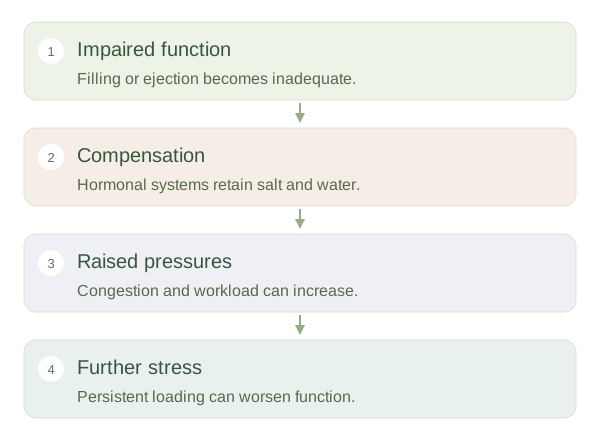 Open diagram larger ↗
Forward flow and backward pressure
If effective output falls, tissues may receive less oxygen during activity, contributing to fatigue and reduced exercise tolerance. Increased filling pressures can transmit backwards into veins. Elevated left-sided pressures can promote fluid accumulation in the lungs, while right-sided can contribute to swelling in the legs or abdominal organs. The sides interact, so these are patterns rather than wholly separate diseases. Fluid accumulation reflects altered pressure and regulation, not simply a hole leaking blood from the heart. Symptoms depend on the cause, severity and other illnesses.
Compensation can become harmful
The body responds to reduced effective circulation by activating sympathetic signals and hormone systems that conserve salt and water. These responses can initially support pressure and perfusion, but persistent activation may worsen and cardiac workload. Ventricular enlargement or thickening can also change performance over time. Causes include coronary disease, longstanding hypertension, valve disorders and cardiomyopathies. Different causes require different clinical evaluation; the phrase alone does not specify one damaged structure. The useful model combines pump mechanics, filling pressures, circulating volume and feedback responses, showing why the syndrome affects the whole body rather than only the chest.