Airways that narrow too readily
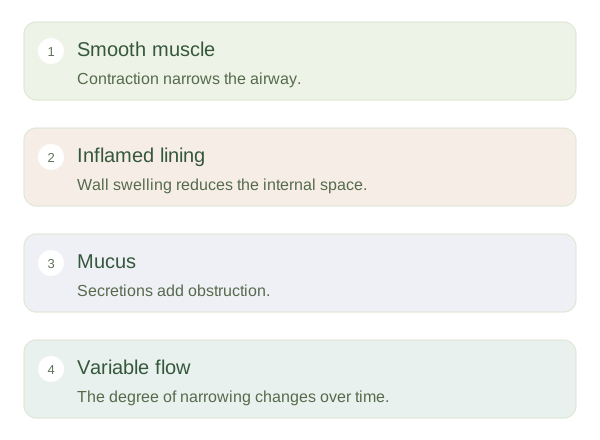
is a chronic airway disorder involving inflammation and variable airflow limitation. The airways can become unusually responsive to triggers, including allergens, respiratory infections, exercise or irritants, although patterns differ between people. Smooth muscle around the airway can contract, the lining can swell and mucus can add obstruction. A smaller airway radius creates much greater resistance to flow. Breathing out can become particularly difficult because the airways also narrow naturally as surrounding lung volumes fall during expiration.
Several causes of airway narrowing
 Open diagram larger ↗
Why symptoms change
Wheeze, cough, chest tightness and breathlessness can come and go. Different exposures, time of day and treatment affect the amount of narrowing. Symptoms may be absent between episodes, so one normal examination does not necessarily exclude . measures how much air is exhaled and how quickly; repeating measurements or observing change after a can help demonstrate variable airflow limitation. However, no single sound or isolated result identifies every case. Asthma can also exist alongside other respiratory problems, which is why symptoms are interpreted in context.
Opening the airway and controlling inflammation
A relaxes airway smooth muscle, while anti-inflammatory medicines target a different part of the process. This explains why immediate improvement in airflow and longer-term control are related but distinct goals. The lungs are not simply blocked by one fixed object. Repeated inflammation can also contribute to longer-term structural changes in some people. Severity and risk cannot be judged only by how comfortable someone feels on a particular day. The useful physiological model includes muscle tone, wall swelling and mucus, all acting on airways whose responsiveness varies over time. Clinical care establishes an individual plan rather than relying on a generic symptom checklist.