A shared neighbourhood of ducts
The liver makes bile, which helps the intestine handle dietary fats. The gallbladder stores and concentrates bile between meals, then releases it through its duct into the main biliary pathway. Gallstones are solid deposits that commonly contain cholesterol or bilirubin-related material. Many stay within the gallbladder without causing symptoms. Their effects depend partly on where they travel. A stone inside the storage organ is anatomically different from a stone lodged in a duct, even when the material forming it is the same.
A blockage near converging drainage routes
 Open diagram larger ↗
Location changes the consequence
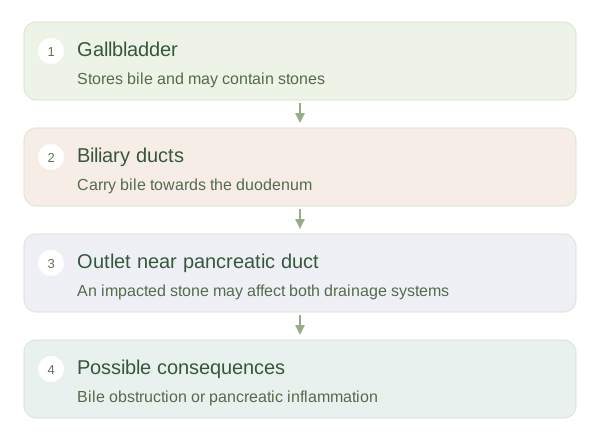
Temporary obstruction of the gallbladder outlet can produce pain as the gallbladder contracts against the blockage. Persistent obstruction may contribute to gallbladder inflammation. A stone in the common can impair bile flow from the liver, sometimes leading to . Near the small intestine, the bile duct and pancreatic duct often share a closely related outlet region. A stone lodged there may interfere with pancreatic drainage and trigger acute . Not every causes pancreatitis, and not every case of pancreatitis is due to gallstones.
When digestive machinery injures its source
is inflammation of the pancreas. In acute disease, inappropriate enzyme activation and inflammatory responses can injure pancreatic tissue and sometimes affect the whole body. The pancreas has both digestive and endocrine roles, so repeated or extensive damage may eventually affect digestion or glucose regulation. Other causes of pancreatitis include alcohol-related injury, medicines and certain inherited conditions. Diagnosis depends on a clinical pattern supported by appropriate tests and sometimes imaging, rather than simply locating pain. The main learning point is anatomical: two organs can be affected by one small blockage when their drainage routes converge near the same destination.