Water is an active setting
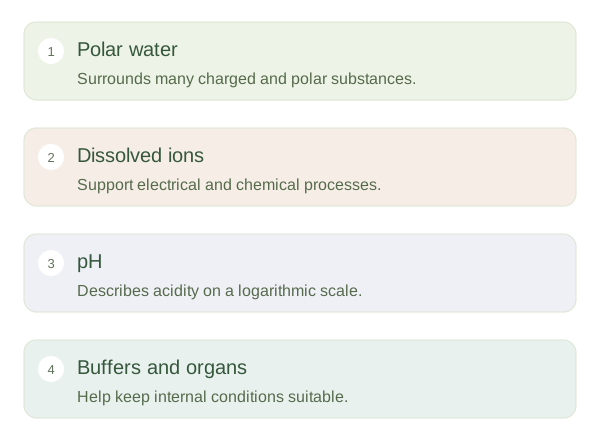
Most reactions in the body occur in water. A water molecule has an uneven distribution of electrical charge, making it polar. This allows water to surround many charged particles and other polar substances, helping them dissolve. Blood plasma and the fluid inside cells are therefore solutions containing many different substances. Water also absorbs considerable heat before its temperature rises greatly, helping stabilise body temperature. It is not a universal solvent: fats do not mix freely with water, which is important for the construction of cell membranes.
Water, Ions and pH
 Open diagram larger ↗
Dissolved charges
An is an atom or group of atoms with an electrical charge. Sodium, potassium, calcium and chloride are important examples. Substances that release ions in water are called electrolytes because the solution can carry electrical current. Different concentrations inside and outside cells help generate nerve and muscle signals. Calcium also supports processes such as contraction and clotting. A charge does not make an ion inherently harmful; its identity, concentration and location determine its effect. The kidneys, lungs and hormones help maintain this carefully controlled chemical environment.
Keeping acidity in range
describes hydrogen activity: a lower value means greater acidity. The scale is logarithmic, so one pH unit represents a tenfold change rather than a small equal step. Enzymes and other proteins depend on suitable acidity to maintain their shape and function. Buffers reduce sudden pH changes by accepting or releasing hydrogen ions. They are supported by ventilation, which adjusts carbon dioxide, and by kidney handling of acids and bicarbonate. Different compartments need different conditions: acidic stomach contents are useful for digestion, while blood is maintained within a narrow, slightly alkaline range.