Pressure provides a driving force
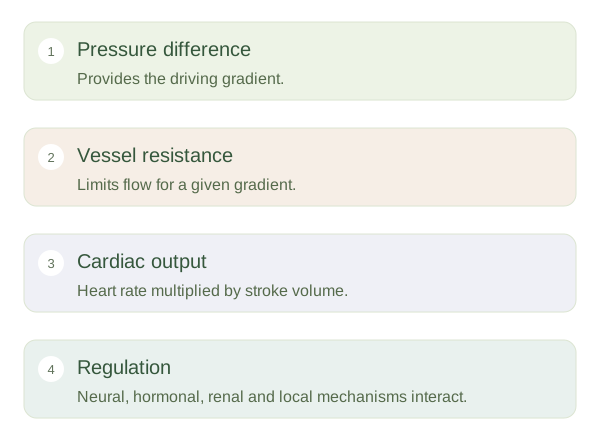
is the force exerted by blood against vessel walls, expressed relative to a reference. Flow occurs from higher towards lower pressure along a connected pathway. The pressure difference between the start and end matters more for flow than one isolated pressure value. Systolic arterial pressure is the peak during ventricular ejection, while diastolic pressure is the lower arterial pressure between ejections. Elastic recoil means arterial pressure does not normally fall to zero each time the ventricles relax. Pressure changes continuously through the circuit.
Blood Pressure and Blood Flow
 Open diagram larger ↗
Resistance shapes the flow
describes opposition to flow. Vessel radius is especially important: narrowing a small artery or arteriole can greatly increase resistance, while widening reduces it. Blood viscosity and vessel length also contribute. In simple terms, flow increases with a larger pressure difference and decreases with higher resistance. Real circulation is more complex than an ideal straight tube, but this relationship is a useful starting model. Arterioles regulate distribution among tissues, so exercising muscle can receive more blood without every organ needing exactly the same increase.
Pressure and output interact
is the volume pumped by one ventricle per minute, equal to heart rate multiplied by . Mean arterial pressure is influenced by cardiac output and systemic vascular , with venous pressure also part of the full relationship. The nervous system, hormones, kidneys and local tissue signals contribute to regulation over different timescales. A high pressure reading does not automatically mean every tissue has high flow: resistance and the individual pathway still matter. Distinguish pressure, flow and volume whenever studying circulation. They are related quantities, but each answers a different question about the movement and distribution of blood.