An automatic rhythm with flexible control
Most breaths occur without conscious thought. Networks in the and pons, parts of the brainstem, generate and adjust respiratory activity. Motor signals travel to the diaphragm and other respiratory muscles. You can briefly change this pattern to speak, sing or hold your breath, but chemical and protective signals continue to influence the system. Automatic breathing is therefore not simply a fixed timer; it adapts to metabolism, behaviour and incoming sensory information.
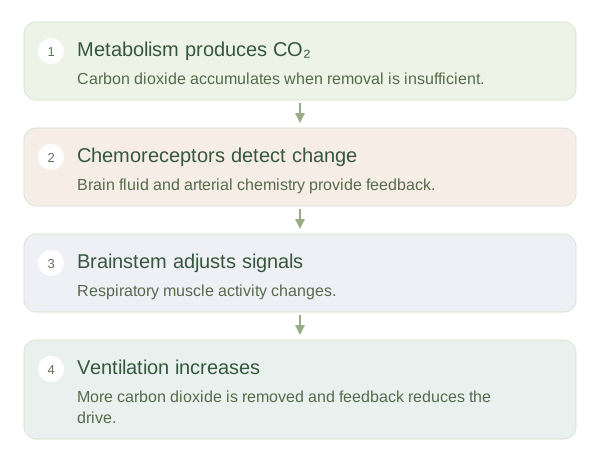
Brainstem rhythms are adjusted by carbon dioxide, acidity and oxygen signals.
 Open diagram larger ↗
Carbon dioxide is a powerful signal
When cells use energy, they produce carbon dioxide. Rising arterial carbon dioxide tends to lower , meaning increased acidity. Carbon dioxide crosses into the fluid around the brain, where resulting chemical changes stimulate central chemoreceptors. Under usual conditions, this provides a major drive to increase . Deeper or faster breathing removes more carbon dioxide, bringing the chemical conditions back towards their normal range. The brain does not need to count every molecule of oxygen used by every cell.
Other signals also matter
Peripheral chemoreceptors in the carotid and aortic bodies respond to arterial chemistry. They are especially important when arterial oxygen falls substantially, and also respond to carbon dioxide and acidity. During exercise, movement-related neural signals and other inputs increase before large disturbances necessarily develop in arterial gases. Stretch and irritant receptors also influence breathing and protective responses such as coughing. Oxygen and carbon dioxide control should not be reduced to the misleading rule that oxygen never matters. Their relative influence changes with circumstances and illness. The central lesson is a feedback loop: respiratory muscles alter ventilation, ventilation changes blood gases, and sensors report those changes to the brainstem. This coordinated control keeps gas exchange aligned with the body’s changing needs.