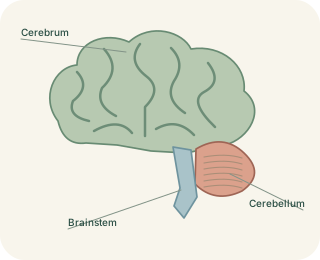
A bridge with essential control centres
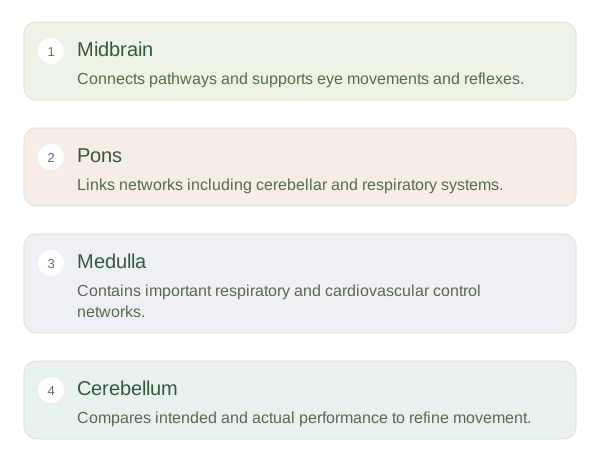
The consists of the midbrain, pons and medulla. It connects higher brain regions with the spinal cord and contains many pathways carrying sensory and motor information. It also contains nuclei associated with most cranial nerves. Some brainstem networks regulate breathing, cardiovascular function, swallowing and other essential activities. Others contribute to arousal, eye movements and reflex responses. Its small size therefore does not mean its functions are minor.
The brainstem connects and regulates; the cerebellum refines performance.
 Open diagram larger ↗
A coordinator behind the brainstem
The lies behind the pons and medulla. It receives information about intended movements as well as feedback from the body and vestibular system. It helps compare plans with what is actually happening, allowing corrections in timing, force and coordination. Think of carrying a full cup: coordinated adjustment helps prevent spilling even while the rest of the body moves. The cerebellum does not simply order a muscle to contract; it improves the precision and adaptation of movement through its connections with other motor systems.
Learning through error
Repeated practice allows cerebellar circuits to adjust performance. Learning to balance or improve the timing of a movement involves more than stronger muscles: neural predictions become better matched to the task. Cerebellar injury may produce unsteady gait, inaccurate reaching or poorly timed movements without necessarily causing complete paralysis. injury may affect very different functions depending on the pathways and nuclei involved. Neither region operates alone; the cerebral cortex, basal nuclei, spinal cord and sensory systems all contribute. The useful distinction is that the brainstem is a major route and regulator for essential functions, whereas the is especially important for coordinating and adapting performance. Both regions also have roles beyond this introductory motor-focused description.