A central route with local processing
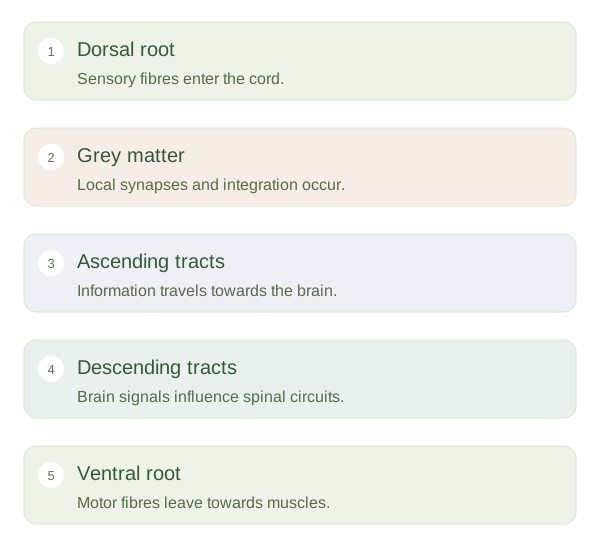
The spinal cord lies within the vertebral canal. It connects the brain with much of the body, but it is also a processing structure in its own right. In cross-section, central resembles a butterfly. It contains neuronal cell bodies, synapses and local circuits. Surrounding contains many axons travelling in organised bundles called tracts. The colours reflect tissue composition, not whether an area is active or inactive.
The spinal cord integrates local circuits and carries signals between body and brain.
 Open diagram larger ↗
Information enters and leaves differently
Sensory information enters through dorsal roots. Sensory neuron cell bodies lie in ganglia, outside the spinal cord. Motor signals to skeletal muscles leave through ventral roots. Dorsal and ventral roots join to form mixed spinal nerves, which contain both sensory and motor fibres. This separation explains how injury to one root can produce a different pattern from injury to a mixed peripheral nerve. Roots at different spinal levels serve different, partly overlapping body territories.
Long pathways have organised jobs
Ascending tracts carry information towards the brain. Different pathways convey aspects of touch, body position, pain and temperature. Descending tracts influence movement and other functions. Many important pathways cross from one side to the other, but they do so at different levels. Consequently, the effects of an injury depend on which is affected and where the injury occurs. The cord usually ends around the upper lumbar vertebral level in adults; lower nerve roots continue as the cauda equina. This matters because the cord’s segments do not align perfectly with similarly numbered vertebrae. A useful map therefore includes local grey-matter circuits, entering sensory roots, leaving motor roots and travelling white-matter pathways rather than treating the cord as one undifferentiated cable.