Regulation beyond conscious commands
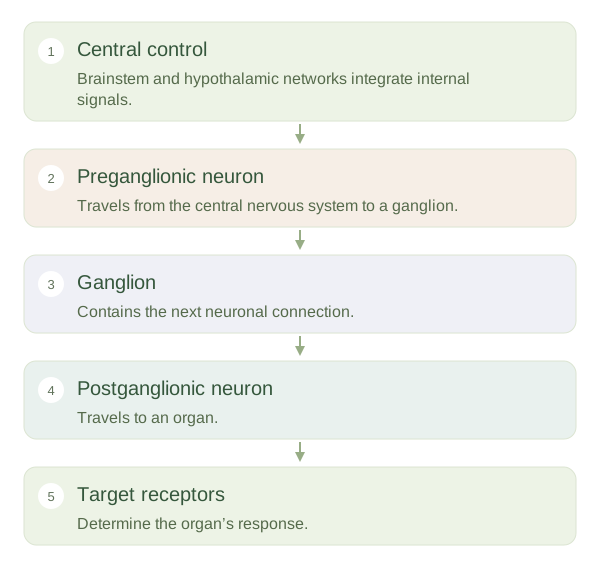
The influences cardiac muscle, smooth muscle and glands. It helps regulate heart rate, blood-vessel tone, digestion, sweating and many other internal functions. Unlike the usual skeletal motor pathway, an autonomic output commonly uses two neurons: one travels from the central nervous system to a , and another travels from that ganglion to the target. A ganglion is a collection of neuronal cell bodies outside the brain and spinal cord.
Autonomic pathways adjust organ function through coordinated, ongoing activity.
 Open diagram larger ↗
Two major patterns of output
Sympathetic activity commonly supports readiness for action. It can increase heart rate, alter blood distribution and stimulate sweating. Parasympathetic activity commonly supports functions such as digestion and slowing the heart. These broad patterns are useful introductions, but neither division is simply good or bad. Both are necessary. Many organs receive input from both, while some targets, including most systemic blood vessels and sweat glands, are predominantly controlled by sympathetic fibres.
Tone and receptors shape the response
Autonomic activity continues at rest. This background tone allows a system to increase or decrease its influence rapidly. A chemical messenger also does not have one universal effect: the response depends on receptor types and the target tissue. For example, sympathetic signalling can produce different effects in different vascular beds and organs. Brainstem and hypothalamic networks integrate signals about blood pressure, temperature and other conditions to adjust output. Digestive control additionally involves extensive local enteric networks. Thinking of the autonomic system as a pair of competing pedals is sometimes helpful, but incomplete. It is better understood as coordinated control that distributes resources and maintains internal conditions. Changes in one organ are often linked with changes elsewhere, allowing the body to respond as a whole rather than making every internal adjustment independently.