A reservoir with active mixing
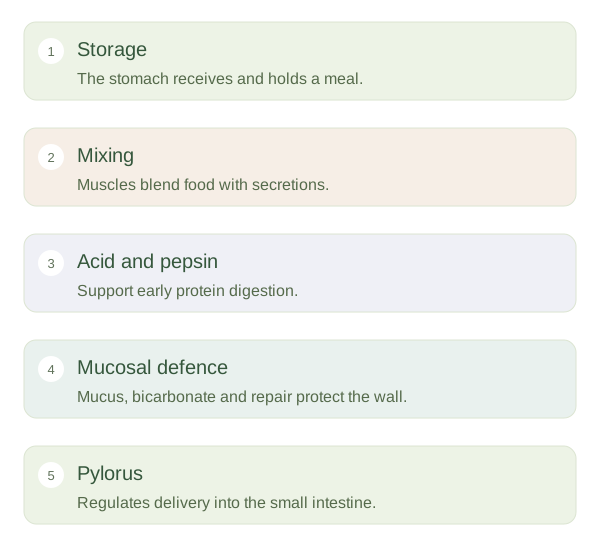
The stomach receives swallowed material and releases it gradually into the small intestine. Its muscular wall churns food with gastric secretions to form , a partly digested mixture. Different regions contribute to storage and mixing, while the pyloric region regulates onward movement. This controlled delivery prevents the small intestine from receiving an entire meal at once. The stomach is therefore more than a bag of acid, and food does not simply fall straight through it.
The stomach stores and mixes food while protecting itself from acid and enzymes.
 Open diagram larger ↗
Acid helps create the right conditions
Parietal cells secrete hydrochloric acid. The acidic environment helps unfold proteins and supports conversion of pepsinogen into , a protein-digesting enzyme. Chief cells release pepsinogen, an inactive precursor that reduces the risk of enzyme action inside the secreting cell. Parietal cells also make , which is needed later for effective vitamin B12 absorption in the ileum. Acid secretion is regulated by neural and chemical signals, including gastrin, rather than remaining at one fixed maximum level.
Why the stomach does not normally digest itself
A mucus-bicarbonate layer helps protect the surface. Tight connections between epithelial cells, good blood supply and rapid repair also contribute. These defences do not make the lining indestructible. Disruption by factors such as Helicobacter pylori infection or certain medicines can contribute to ulcer formation. The small intestine must also neutralise much of the arriving acidity so its own enzymes and lining can function well. Digestion therefore depends on location: acid is useful in the stomach but needs control and protection. The key relationship is between secretion, mixing, regulated emptying and barriers that keep powerful digestive chemistry where it can help rather than harm.