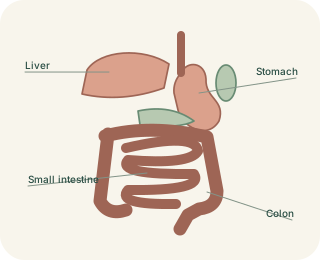
Production and storage are separate
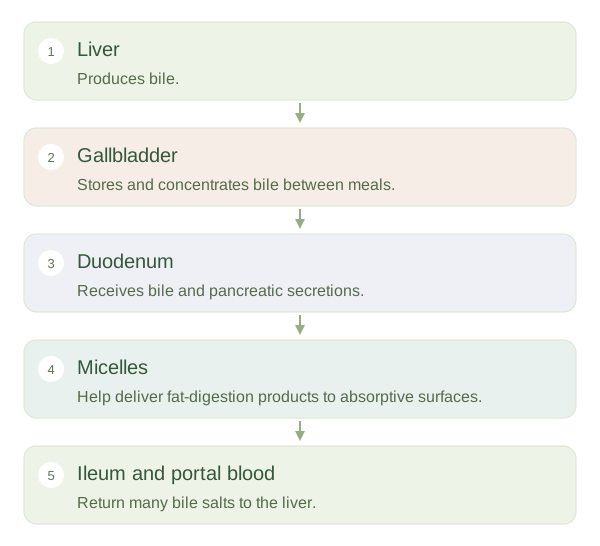
The liver continuously produces , a fluid containing bile salts, pigments and other substances. Bile travels through ducts. Between meals, some is directed into the gallbladder, where it is stored and concentrated. During a meal, especially one containing fat, signals including cholecystokinin promote gallbladder contraction and delivery into the duodenum. The gallbladder does not manufacture all the bile itself. People can live without it because the liver continues to produce bile, although the pattern of delivery changes.
The liver makes bile; the gallbladder stores it; bile salts help handle fat.
 Open diagram larger ↗
Helping water and fat cooperate
Dietary fat tends to gather into droplets in the watery intestinal contents. salts have properties that help disperse fat and support formation of small transport structures called micelles. This increases access for pancreatic lipase and helps carry fat-digestion products towards the intestinal surface. Bile is not a digestive enzyme: it assists physical handling and absorption rather than cutting every fat molecule by itself. Lipase performs chemical breakdown, and intestinal cells then process the absorbed products.
A recycling and waste route
Many salts are reabsorbed near the end of the small intestine and returned to the liver through portal blood. This enterohepatic circulation allows reuse rather than requiring complete replacement after every meal. Bile also carries , a pigment arising from haemoglobin breakdown, towards the intestine for elimination. Obstruction of bile flow can therefore affect both fat handling and pigment disposal. Jaundice is yellowing associated with bilirubin accumulation, but it has several possible causes and does not identify one obstruction by itself. The useful map links the liver, ducts, gallbladder and intestine while keeping three jobs distinct: manufacture, timed delivery and assistance with fat absorption.