Large food molecules need processing
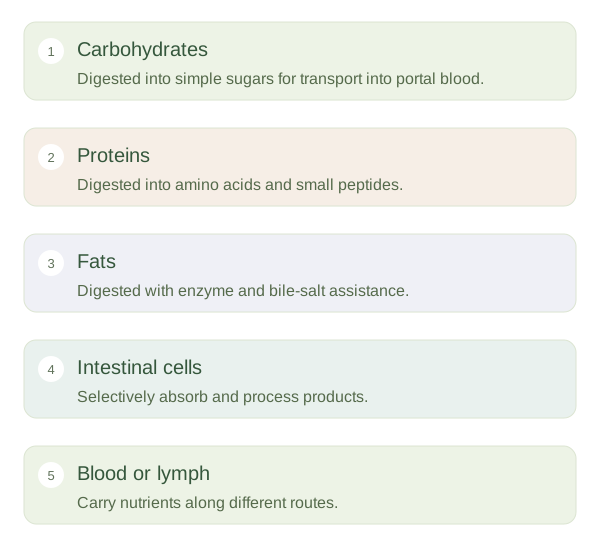
Most dietary carbohydrates, proteins and fats cannot simply cross the intestinal lining in their original form. Digestive enzymes break them into smaller products. Starch becomes sugars that are eventually reduced to absorbable monosaccharides. Proteins become amino acids and small peptides, which intestinal cells further process. These products cross the epithelium using specific transport systems. Many then enter villus capillaries and travel through portal blood towards the liver.
Different nutrients need different digestive and transport routes.
 Open diagram larger ↗
Fat follows a different route
Pancreatic lipase helps break triglycerides into fatty acids and monoglycerides. Bile salts support micelles that bring these products close to intestinal cells. Inside the cells, many long-chain fatty acids are reassembled into triglycerides and packaged into chylomicrons. These particles enter lacteals and travel through lymph before reaching the blood. Shorter-chain fatty acids can follow different routes, including direct portal transport. The common teaching that all fat always takes one identical route is therefore too absolute.
Absorption requires a working surface
Digestion and absorption are related but distinct. Enzymes can produce small molecules, yet damaged transport cells may still fail to absorb them effectively. Conversely, healthy intestinal cells cannot absorb large quantities of nutrients that have not been adequately digested. Water follows osmotic gradients, and electrolyte transport helps shape fluid movement. Different nutrients also have specific requirements; for example, vitamin B12 absorption depends on intrinsic factor and the terminal ileum. This organised division of work explains why problems in the pancreas, bile delivery, intestinal lining or transport proteins can produce different patterns of . Thinking about the route from food molecule to digestive product, then through a cell and into blood or lymph, provides a useful framework for understanding nutrition without needing to memorise every individual transporter.