Salt handling influences volume
Sodium is a major extracellular ion. Changes in total body sodium often influence extracellular fluid volume because water accompanies retained solute under normal regulatory conditions. By adjusting sodium excretion, the kidneys help determine how much fluid remains in the circulation and surrounding tissues. Blood pressure also depends on cardiac output and vascular resistance, so sodium balance is important without being the only determinant. The kidneys continuously integrate these relationships rather than responding to salt through one isolated switch.
Kidneys regulate long-term blood pressure partly by controlling sodium and water balance.
 Open diagram larger ↗
A hormone cascade responds to reduced delivery
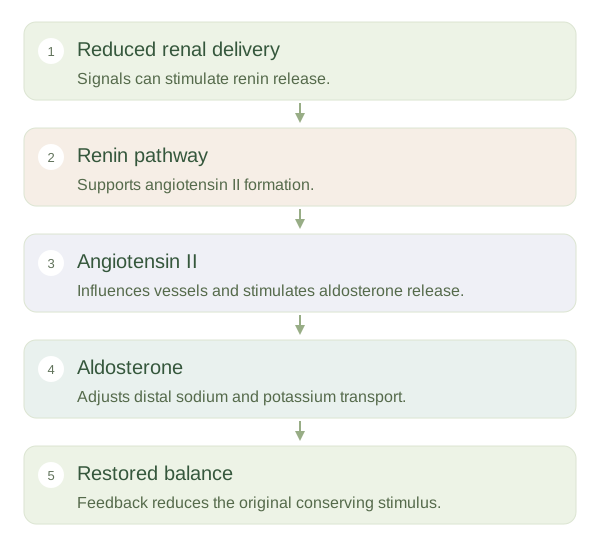
Specialised kidney cells can release when signals suggest reduced perfusion or sodium delivery. Renin begins a sequence leading to formation. Angiotensin II can constrict blood vessels and promote several volume-conserving responses, including release from the adrenal cortex. Aldosterone increases sodium reabsorption in selected distal nephron regions and promotes potassium secretion. Water retention depends on water availability and other controls, including ADH; aldosterone does not directly make every membrane freely permeable to water.
Feedback prevents simple one-way thinking
Restoring circulation and sodium delivery tends to reduce the original stimulus. Other systems, including natriuretic peptides released when cardiac chambers are stretched, can favour sodium excretion and oppose excessive volume expansion. Local kidney mechanisms also help stabilise filtration across a useful pressure range. These responses interact with nerves, hormones and vascular properties. This is why long-term blood-pressure regulation cannot be understood solely as the heart squeezing harder. The kidneys influence the amount of fluid the heart circulates, while the circulation determines kidney perfusion. Understanding this partnership provides a foundation for later learning about hypertension, fluid retention and why some medicines alter kidney sodium handling.