A continuous exchange
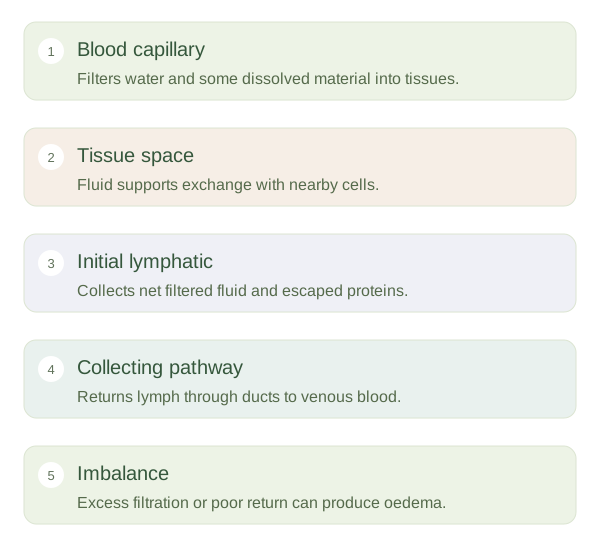
Capillary walls allow water and small dissolved substances to move between blood and the spaces around cells. tends to push fluid outward, while proteins retained in plasma contribute to an osmotic force that favours keeping water within the circulation. The detailed balance varies across tissues. A useful modern picture is that lymphatic return is essential for recovering the net filtered fluid and proteins; most tissues do not simply reclaim all arterial-end filtration at the venous end.
The tissue-fluid balance
 Open diagram larger ↗
Lymphatics recover what remains
Initial lymphatic vessels receive fluid when tissue pressure opens overlapping endothelial flaps. They also collect proteins that have escaped from blood capillaries. Returning proteins matters because retained tissue proteins attract water and can worsen swelling. Collecting vessels carry the lymph through nodes and towards large ducts, which empty into veins near the lower neck. In this way, a separate low-pressure return route complements the blood circulation.
When balance is disturbed
means excess fluid within tissues. It can occur when capillary pressure rises, plasma protein concentration falls, capillary increases or lymphatic drainage becomes inadequate. These are mechanisms, not interchangeable diagnoses. Heart failure can increase venous and capillary pressures, while inflammation can make vessels leakier. Damage or obstruction of lymphatic vessels may cause . More than one mechanism can operate at the same time.
Why movement helps but is not the whole answer
Muscle contractions and breathing-related pressure changes assist lymph movement, while valves limit backflow. This explains why prolonged immobility may contribute to dependent swelling. However, swelling is not always a sign of simply needing more movement: causes include vascular, renal, cardiac, inflammatory and lymphatic conditions. The central concept is a balance of entry and return. A tissue can become swollen either because too much fluid arrives or because its return pathway cannot keep up.