Layers with different roles
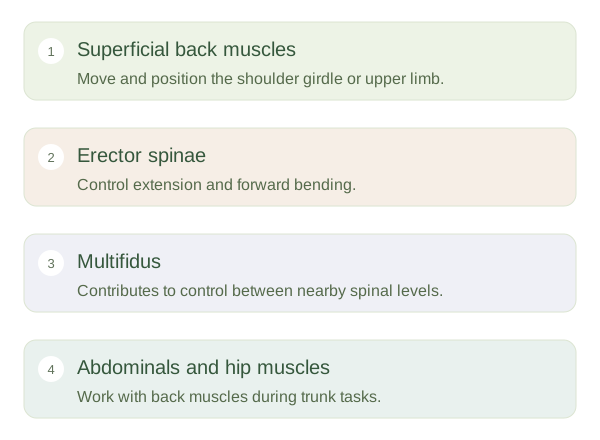
The back contains several layers of muscles. Superficial muscles such as trapezius and latissimus dorsi influence the shoulder girdle or upper limb. Deeper intrinsic back muscles act more directly on the vertebral column and head. The group runs along the back on either side of the spine and helps extend it. Smaller muscles, including , connect nearby vertebrae and contribute to segmental control. These layers overlap anatomically, so a muscle can be located on the back without primarily being a spinal movement muscle.
Back Muscles and Posture — concept map
 Open diagram larger ↗
Opposing gravity
When you lean forward, gravity tends to increase the forward bend of your trunk. Back muscles may contract while lengthening to control this movement; this is an . When you return upright, coordinated muscle activity helps extend the trunk. Abdominal muscles also contribute by controlling the trunk and influencing pressure within the abdomen. Muscles around the hips participate as well. Postural support is therefore a coordinated task involving the spine, pelvis, breathing system and limbs, rather than a contest between a strong back and a weak abdomen.
Fine control and feedback
Sensory receptors in muscles and joints provide information about movement and position. The nervous system uses this feedback to adjust contraction as a person reaches, carries a bag or changes footing. Many stabilising contractions are small and happen without deliberate attention. Holding any position for a long time can produce fatigue, even if that position initially feels comfortable. Anatomy helps explain why normal movement and variation matter: the system is designed to adapt to changing demands. A photograph of posture cannot reveal the full pattern of muscle activity or determine the cause of pain. Structure provides the possibilities, while coordination determines how they are used.