When disc material moves
The outer annulus of a disc normally contains its inner material. With degeneration or injury, part of the disc may protrude or pass through damaged outer layers; this is a . The disc does not literally slip out as a whole. Depending on its direction and size, displaced material can approach a , the spinal cord at upper levels, or the cauda equina below the cord. Both mechanical pressure and inflammation can disturb a nearby root. Many disc changes, however, are found in people who have no related symptoms.
Disc Herniation and Nerve Compression — concept map
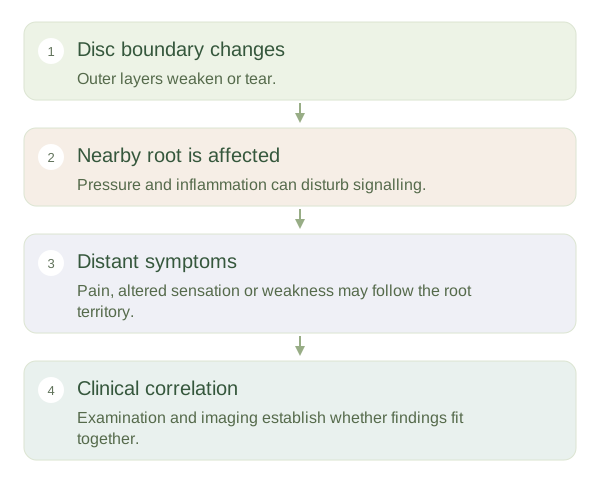 Open diagram larger ↗
Why pain can travel
A contains fibres connected to a wider body territory. Irritation near the spine may therefore be experienced as pain, tingling or altered sensation farther along that territory. When a lumbar or sacral root is affected, symptoms may extend into a leg. This pattern is called ; the familiar word sciatica describes certain leg-pain patterns rather than one single cause. Motor fibres may also be affected, producing weakness, and reflexes can change. Local back pain and nerve-root symptoms are not the same phenomenon, even though they can occur together.
Location and context matter
A posterolateral lumbar herniation commonly affects a root travelling towards the next lower exit. For example, an L4–L5 disc can affect the traversing L5 root, although the precise pattern depends on the position of the lesion. Diagnosis combines symptoms, examination and imaging; an image alone cannot establish that a visible disc change causes pain. Widespread root compression can disturb bladder, bowel or saddle-region sensation and is clinically urgent. This article explains the anatomy rather than providing a self-diagnosis rule. The central lesson is spatial: a small structure can have distant effects when it interferes with a nerve pathway.