A branching network
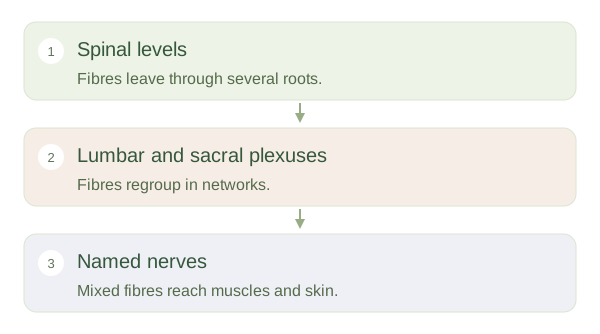
A is a network in which nerve fibres from several spinal levels regroup into peripheral nerves. The lumbar plexus forms mainly from the anterior rami of L1 to L4 within the posterior abdominal wall. Its important lower-limb branches include the femoral and obturator nerves. The sacral plexus includes contributions from L4 to S4 and lies on the posterior pelvic wall. It gives rise to the sciatic and gluteal nerves, among others. These networks link the spinal cord to muscles, joints and skin in the lower limb.
From levels to territories
 Open diagram larger ↗
Roots are not the same as named nerves
A represents one level entering or leaving the spinal cord. A peripheral nerve usually contains fibres from several levels after they have mixed through a . The femoral nerve mainly supplies the anterior thigh, while the obturator nerve supplies much of the medial thigh. The sciatic nerve travels into the posterior thigh and contains tibial and common fibular components. These continue towards the leg and foot. A diagram of a plexus is therefore a routing map, not a chain in which one nerve activates the next.
Why the arrangement matters
Because fibres regroup, damage at a may affect muscles supplied by several named nerves. Damage to one peripheral nerve produces a different combination of weakness and sensory change. Dermatomes describe skin regions associated mainly with spinal levels; peripheral cutaneous territories describe named nerve supply. They overlap and vary between people, so their borders are not precise painted lines. Combining movement testing, sensation and reflexes helps distinguish levels of involvement. The useful principle is that spinal levels and named nerves are two different ways of mapping the same travelling fibres.