Blood arriving at the limb
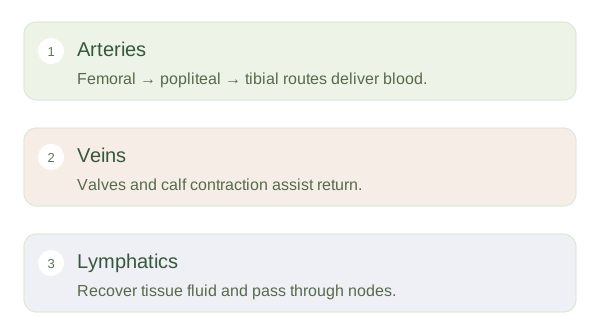
The external iliac artery becomes the femoral artery as it passes beneath the inguinal ligament. A large deep branch supplies the thigh. The main vessel continues through the adductor hiatus and becomes the artery behind the knee. It then supplies the leg through anterior and posterior tibial pathways, with the fibular artery arising from the posterior system. The anterior tibial artery continues onto the foot as dorsalis pedis. These name changes describe location along a connected route, rather than separate pumps for each region.
Three connected transport routes
 Open diagram larger ↗
Returning against gravity
Deep veins accompany major arteries. Superficial veins run in the tissue beneath the skin; the great ascends medially and joins the femoral vein near the groin. The small saphenous vein usually drains towards the vein. Perforating veins connect superficial and deep systems. Venous valves encourage one-way flow, and contracting calf muscles compress deep veins to help move blood towards the heart. When the muscles relax, valves reduce backward flow. This calf pump supports return but does not replace the heart’s pressure relationships.
The third fluid pathway
Some fluid filtered from capillaries enters lymphatic vessels instead of returning directly to veins locally. Superficial lymph from much of the limb reaches inguinal nodes; some lateral foot and posterior leg pathways pass through nodes first. Deep lymphatics follow deep vessels. Lymph eventually rejoins the venous circulation centrally. Venous or lymphatic problems can both contribute to swelling, but by different mechanisms. A useful comparison is a town’s supply, return and overflow systems: all are connected, yet each route carries a different responsibility in maintaining healthy tissue.