Growth needs regulation
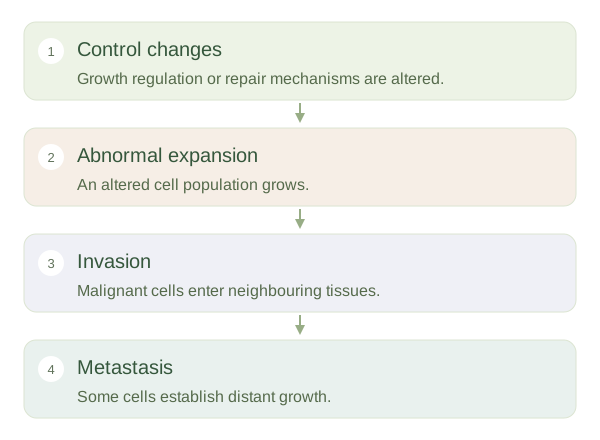
Healthy tissues balance cell division, specialisation, repair and cell death. Genes help regulate these decisions through proteins and signalling networks. Cancer develops when accumulated changes allow a cell population to escape important controls. Some changes favour growth signals; others weaken brakes, DNA repair or programmed cell death. A harmful change can arise during life or be influenced by an inherited predisposition. Cancer is therefore a disease involving genetic changes, but that does not mean every cancer was directly inherited from a parent.
Cancer development and spread
 Open diagram larger ↗
Local growth and invasion
A is an abnormal tissue mass, but tumours can be benign or . Benign tumours do not invade or metastasise in the way cancers do, although their size or location can still cause serious harm. Malignant cells can invade neighbouring tissue and disrupt normal organisation. Some cancers, including many leukaemias, involve blood-forming tissues and do not present as a single solid mass. Appearance, behaviour and molecular features help distinguish cancer types. The word cancer describes a broad family of diseases rather than one uniform growth pattern.
How spread affects the body
occurs when cancer cells establish growth at sites separate from the original , often after travelling through blood or lymph. A breast cancer spreading to bone remains metastatic breast cancer, not a new primary bone cancer. Tumours can interfere with organ function, compete for resources or release substances affecting distant tissues. Immune surveillance, the local environment and blood supply influence their behaviour. Not every abnormal cell progresses to cancer, and several changes usually interact over time. The useful model is a breakdown of coordinated tissue rules, followed in disease by the ability to invade and sometimes colonise elsewhere.