Brain tissue needs continuous supply
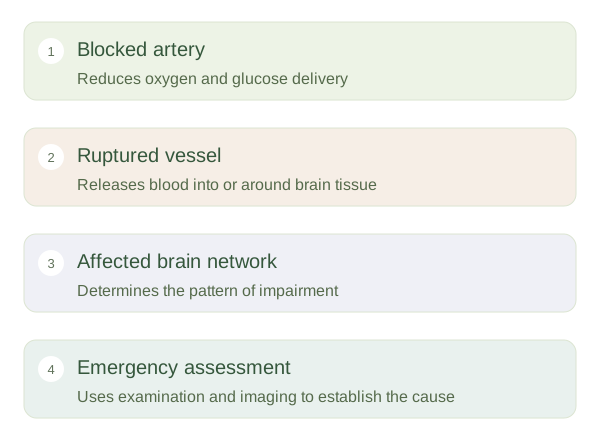
A stroke is sudden brain injury caused by interrupted blood supply or bleeding. In an ischaemic stroke, an artery is blocked, reducing oxygen and glucose delivery to its territory. A clot may form locally or travel from elsewhere, such as the heart. In a haemorrhagic stroke, a vessel ruptures and blood escapes into or around brain tissue. Bleeding can damage tissue directly and raise pressure. The two mechanisms require different assessment and treatment, despite sometimes producing similar outward signs.
Two stroke mechanisms
 Open diagram larger ↗
The location shapes the deficit
Different brain regions and pathways contribute to movement, language, sensation, vision and coordination. Injury to one region may therefore cause sudden weakness, loss of speech, visual change or imbalance. Many motor pathways cross, so injury to one cerebral hemisphere can affect the opposite side of the body. Language effects depend on the networks involved and individual organisation. Not every stroke produces facial droop or weakness, and the absence of one familiar sign does not exclude it. Imaging helps distinguish bleeding from blocked-vessel injury and identify its location.
Time and tissue vulnerability
Brain cells have limited energy reserves, so prolonged interruption of supply can cause irreversible injury. Around an injured core, some tissue may be impaired but potentially salvageable, depending on circulation and time. This is why suspected stroke is an emergency, including sudden symptoms that improve. A causes temporary neurological dysfunction from without the established that defines a completed ischaemic stroke. It still signals urgent risk rather than reassurance. This article explains mechanisms, not how to decide treatment at home: sudden new stroke-like symptoms require emergency medical assessment.