A joint is an interacting system
is a disease involving changes in cartilage, underlying bone, and other joint tissues. normally provides a smooth surface and helps distribute load. It has no direct blood supply and relies on its cells and surrounding environment to maintain its matrix. In osteoarthritis, the balance between tissue maintenance and damage changes. The process is more complex than an old surface simply rubbing away. Bone remodelling, altered mechanics and low-grade inflammatory processes can all contribute to the affected joint’s behaviour.
The whole joint in osteoarthritis
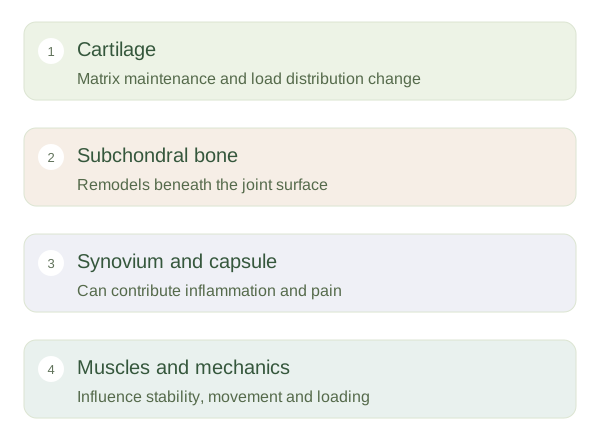 Open diagram larger ↗
Structure and symptoms are related imperfectly
Pain, stiffness and reduced movement are common, but symptoms vary. Cartilage itself lacks pain fibres, so pain arises from other innervated structures such as bone beneath the cartilage, , ligaments and surrounding tissues. Imaging changes do not always match symptom severity. Some people have clear radiographic changes with little pain, while others experience substantial pain with less dramatic images. Joint mechanics, muscle function, previous injury and the nervous system’s processing of signals all influence the experience. An image is therefore one source of evidence rather than a complete measure of disability.
Risk does not mean inevitability
Age increases risk, but is not an unavoidable outcome of every older joint. Previous injury, inherited factors, loading patterns and body composition can contribute in different ways. Knees, hips and small hand joints are commonly affected, although other joints can be involved. Osteoarthritis differs from rheumatoid arthritis, which has a distinct immune-mediated mechanism, even though both can cause painful joints. The useful learning principle is to connect load-bearing structure with active biological responses. Understanding a whole joint and the person using it gives a clearer picture than the phrase wear and tear alone.